Harness LLMs with Multi-Agent Programming
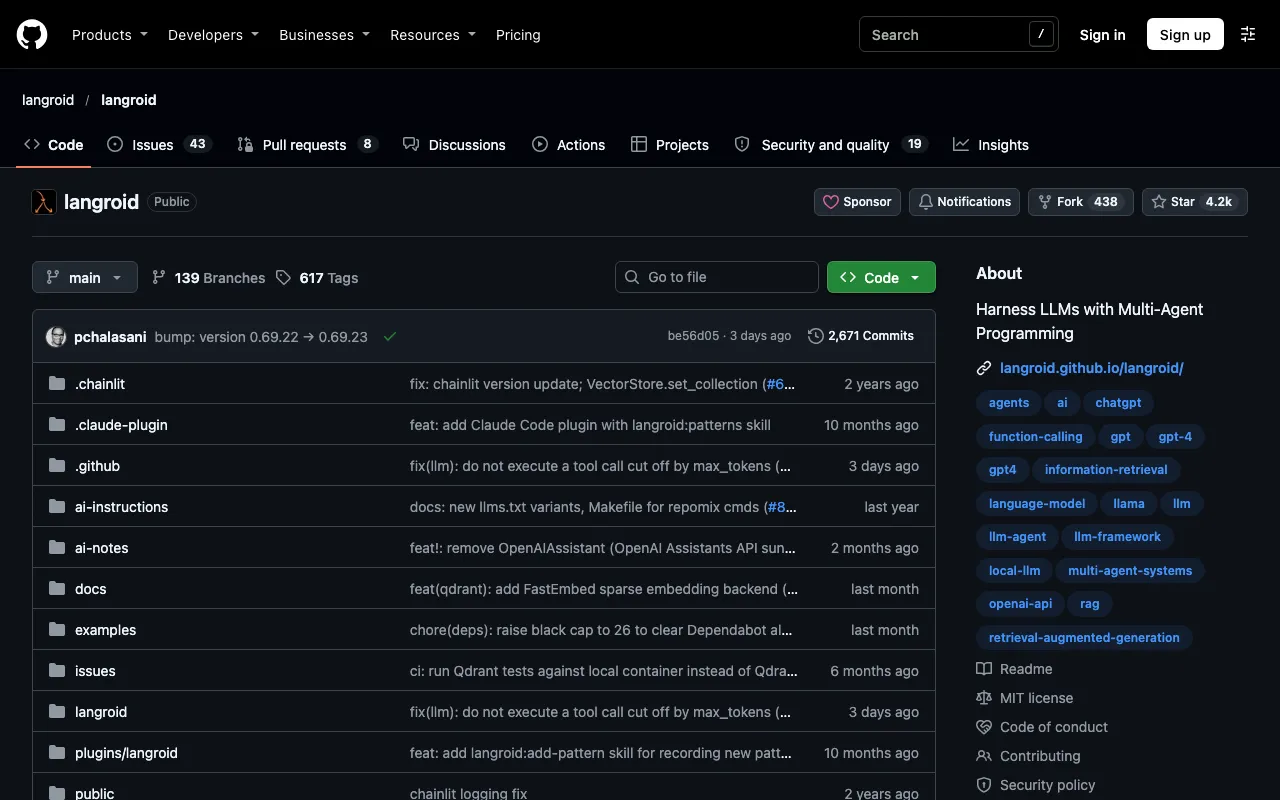
About Langroid
Langroid is an open-source Python framework for building applications with language models, with multi-agent programming as its core idea. It was created by researchers from CMU and the University of Wisconsin-Madison, and it takes inspiration from the actor model.
Agents are the main building blocks, and a Task wraps an agent and manages its interactions, with agents delegating work to one another hierarchically. It does not depend on LangChain or any other LLM framework and works with practically any model. Features include tools and function calling, structured extraction, a DocChatAgent for retrieval over documents with LanceDB as the default vector store, a SQL agent and MCP support, and it logs multi-agent interactions with message lineage for tracing.
It installs with pip. A user testimonial from one company says it chose Langroid over several other frameworks, but that is a vendor-side claim, not an independent comparison.
Key features
- Multi-agent programming with agents as first-class citizens
- Hierarchical task delegation
- Works without LangChain
- Tools and function calling
- DocChatAgent for retrieval
- MCP support
- Logs with message lineage
Links
All content and agents from Langroid
Frequently asked questions about Langroid
- What is Langroid?
- Harness LLMs with Multi-Agent Programming. It is listed on botshub under agent frameworks and sdks.
- Is Langroid free or open source?
- Langroid is tagged as open source on botshub. Check the official site for current terms.
- What can Langroid do?
- Key features include multi-agent programming with agents as first-class citizens, hierarchical task delegation, works without LangChain, tools and function calling and docChatAgent for retrieval.
- What are alternatives to Langroid?
- Other agent frameworks and sdks on botshub include AgentForge, DSPY, LightAgent and Microsoft Agent Framework. See all alternatives to Langroid.