Build autonomous AI agents in Python
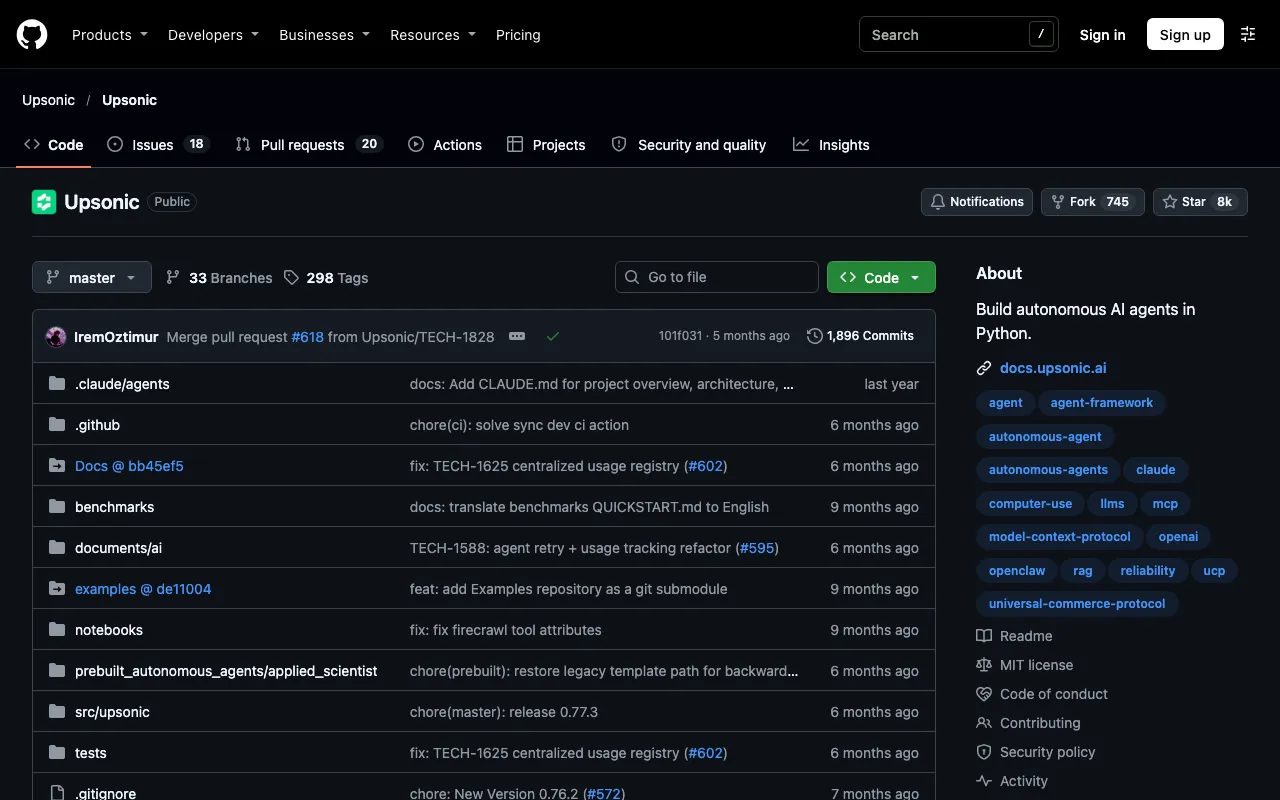
About Upsonic
Upsonic is an open-source Python framework for building AI agents, with safety and MCP support in the foreground. Its Safety Engine applies policies to user inputs, agent outputs and tool interactions, and can block, anonymise, replace or raise errors on matching content, for example removing personal data before a prompt reaches a model.
Pre-built policies cover personal data, adult content, profanity and financial data, and custom policies are supported. Package listings also mention MCP tool integration, human-in-the-loop workflows, OCR, memory and multi-agent coordination, and an AutonomousAgent with filesystem and shell tools that is restricted to a workspace, blocking path traversal and dangerous commands.
The details come from PyPI descriptions across several versions, so the feature set may differ by release, and the safety claims are the project's own. Documentation is at docs.upsonic.ai.
Key features
- Safety Engine for inputs, outputs and tool use
- Pre-built and custom policies
- MCP tool integration
- Human-in-the-loop workflows
- Memory and multi-agent coordination
- AutonomousAgent with workspace sandboxing
Links
All content and agents from Upsonic
Frequently asked questions about Upsonic
- What is Upsonic?
- Build autonomous AI agents in Python. It is listed on botshub under agent frameworks and sdks.
- Is Upsonic free or open source?
- Upsonic is tagged as open source on botshub. Check the official site for current terms.
- What can Upsonic do?
- Key features include safety Engine for inputs, outputs and tool use, pre-built and custom policies, mCP tool integration, human-in-the-loop workflows and memory and multi-agent coordination.
- What are alternatives to Upsonic?
- Other agent frameworks and sdks on botshub include Adala, Agents, Claude Agent SDK and CrewAI. See all alternatives to Upsonic.