Multiplayer agent harness for teams
About QM
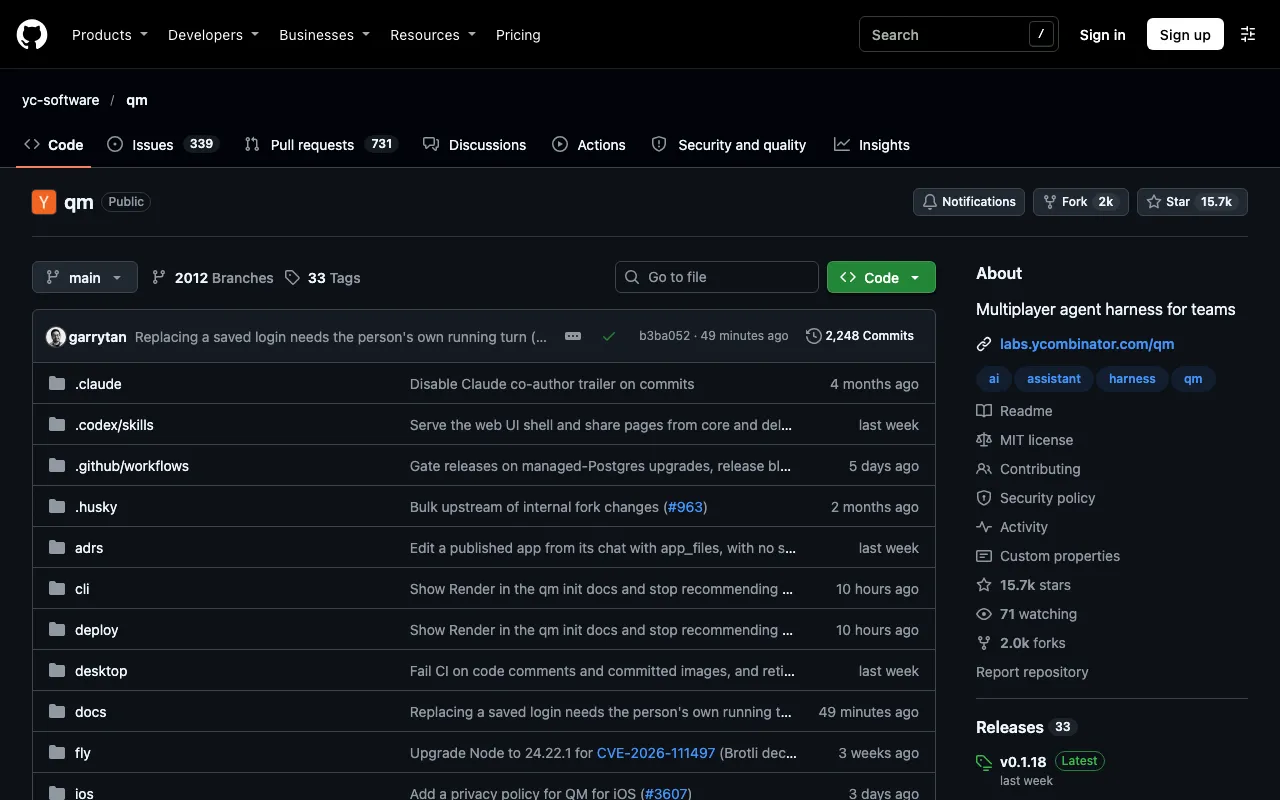
QM is an open-source multiplayer agent harness released by Y Combinator under the MIT licence, with the code at yc-software/qm. It runs in Slack and on the web and is built for teams, not individuals, with the README contrasting it with agents designed as personal assistants. Coverage says each user gets their own files, permissions and memory, and that it can connect to coding agents such as Claude Code, Codex, OpenCode and Pi or to a chosen model when self-hosted.
Y Combinator says it runs QM internally across departments, and one report lists accounting, legal, events and engineering. The release was dated 31 July 2026, and early reports cite thousands of GitHub stars within days. Its own security policy is described as calling it early and experimental, and most details here come from secondary coverage, so check the repository and YC's announcement.
Key features
- Multiplayer agent workspace in Slack and on the web
- Separate files, permissions and memory per user
- Connects to Claude Code, Codex, OpenCode and Pi
- Self-hostable
- Early and experimental
- MIT licence
Links
All content and agents from QM
Frequently asked questions about QM
- What is QM?
- Multiplayer agent harness for teams. It is listed on botshub under agent orchestration and harnesses.
- Where is QM from?
- QM comes from United States.
- Is QM free or open source?
- QM is tagged as open source on botshub. Check the official site for current terms.
- What can QM do?
- Key features include multiplayer agent workspace in Slack and on the web, separate files, permissions and memory per user, connects to Claude Code, Codex, OpenCode and Pi, self-hostable and early and experimental.
- What are alternatives to QM?
- Other agent orchestration and harnesses on botshub include Hive, Raven, Ruflo and Omnigent. See all alternatives to QM.