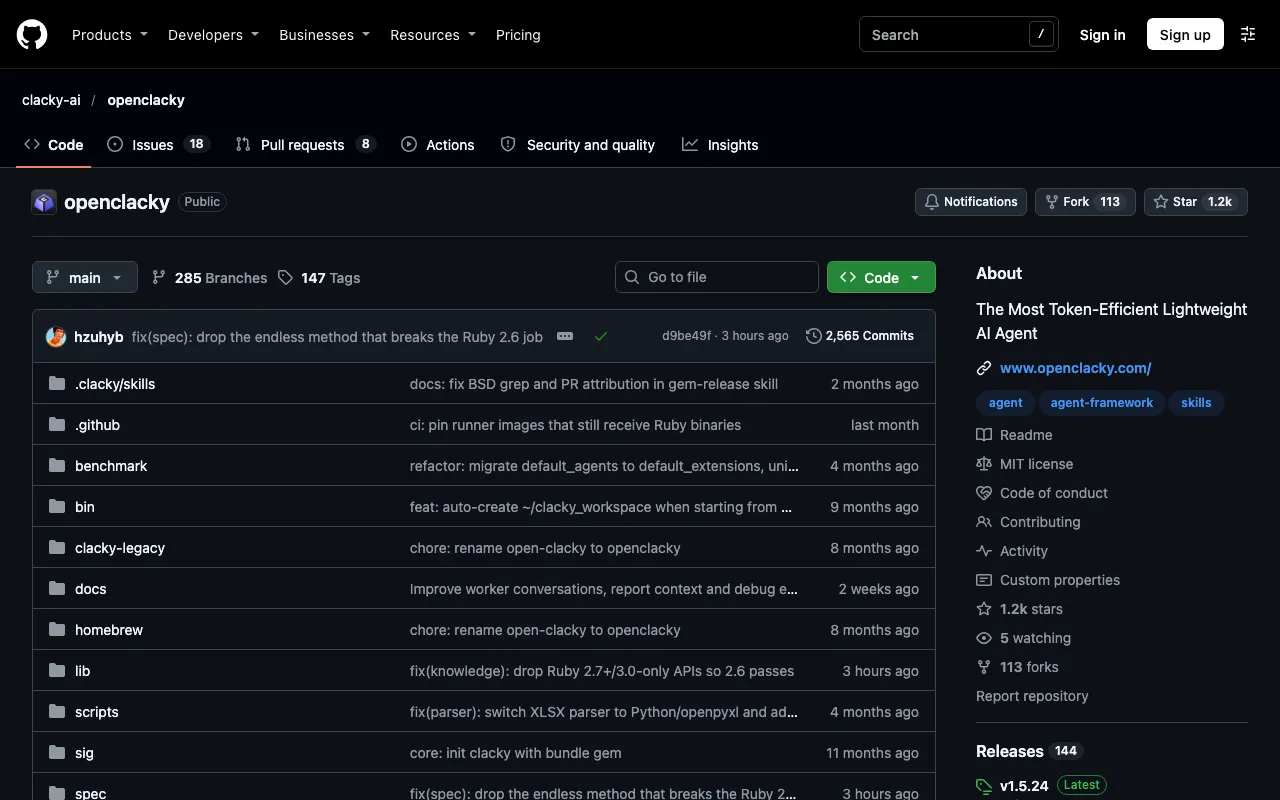
The Most Token-Efficient Lightweight AI Agent
About OpenClacky
OpenClacky is an open-source, MIT-licensed agent from the clacky-ai team, written in Ruby, whose main pitch is token efficiency. It describes itself as the most token-efficient open-source AI agent and claims about 50 percent savings against OpenClaw and roughly three times against Hermes.
A benchmark reported on DEV Community ran four agents on the same three tasks and model and found OpenClacky cheapest, with a Chinese article citing $5.10 against $15.70 and $30.14 for two rivals. These are the project's own numbers and are unverified. Reported reasons include a small toolset of 16 tools, context compression during idle periods and high prompt cache reuse. Other features include skill self-evolution, long-term memory, scheduled tasks, messaging integrations and browser automation.
It installs with a script or gem install openclacky, needs Ruby 3.1 or later and works with any OpenAI-compatible provider. A hard fork called Octo preserves the original copyright.
Key features
- Token-efficient personal agent in Ruby
- 16 built-in tools reported
- Context compression and prompt cache reuse
- Skills with self-evolution
- Long-term memory and scheduled tasks
- Any OpenAI-compatible provider
- MIT licence
Links
All content and agents from OpenClacky
Frequently asked questions about OpenClacky
- What is OpenClacky?
- The Most Token-Efficient Lightweight AI Agent. It is listed on botshub under ai assistants.
- Where is OpenClacky from?
- OpenClacky comes from United States.
- Is OpenClacky free or open source?
- OpenClacky is tagged as open source on botshub. Check the official site for current terms.
- What can OpenClacky do?
- Key features include token-efficient personal agent in Ruby, 16 built-in tools reported, context compression and prompt cache reuse, skills with self-evolution and long-term memory and scheduled tasks.
- What are alternatives to OpenClacky?
- Other ai assistants on botshub include AnythingLLM, Atomic Agent, OpenBot and XAgent. See all alternatives to OpenClacky.