Your lightweight open-source personal agent
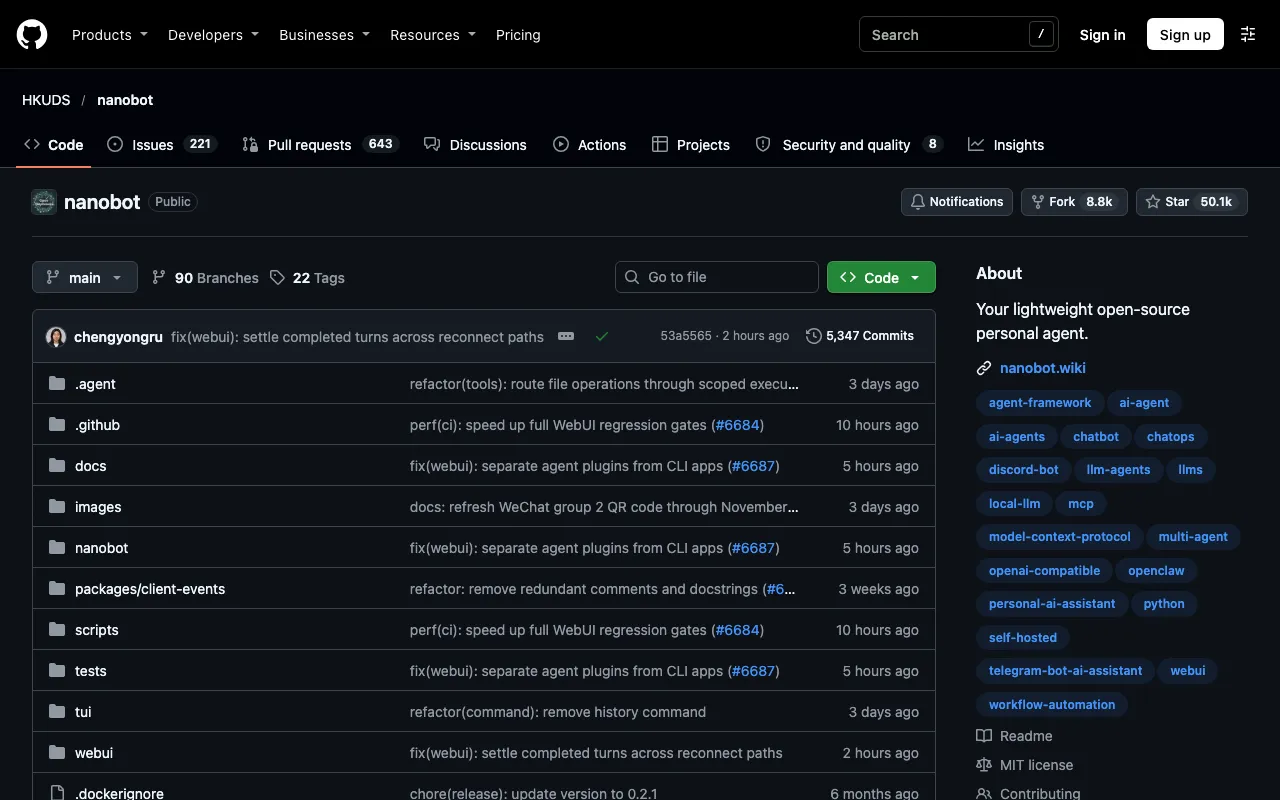
About nanobot
nanobot is an open-source personal AI assistant from the Hong Kong University Data Intelligence Lab, built to be small and readable. Its repository calls it ultra-lightweight and inspired by OpenClaw, with a core agent of about 4,000 lines, which it says is 99 percent smaller than Clawdbot. It launched officially on 2 February 2026.
Beyond the core loop it offers a web interface, chat adapters for Telegram, Discord, Slack and WeChat, tools, memory, MCP, model routing and fallback, automation and deployment through a gateway. It can run with local models through vLLM or any OpenAI-compatible server, is MIT licensed and installs from PyPI as nanobot-ai.
Third-party trackers report roughly 44,000 stars, but figures vary by source and date.
Key features
- Ultra-lightweight personal agent, about 4,000 lines of core code
- Telegram, Discord, Slack and WeChat
- Web interface
- Memory, MCP and model routing
- Local models through vLLM
- MIT licence
Links
All content and agents from nanobot
Frequently asked questions about nanobot
- What is nanobot?
- Your lightweight open-source personal agent. It is listed on botshub under ai assistants.
- Where is nanobot from?
- nanobot comes from Hong Kong.
- Is nanobot free or open source?
- nanobot is tagged as open source on botshub. Check the official site for current terms.
- What can nanobot do?
- Key features include ultra-lightweight personal agent, about 4,000 lines of core code, telegram, Discord, Slack and WeChat, web interface, memory, MCP and model routing and local models through vLLM.
- What are alternatives to nanobot?
- Other ai assistants on botshub include QwenPaw, Trustclaw, Jan and Lobe Chat. See all alternatives to nanobot.